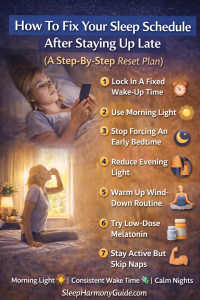
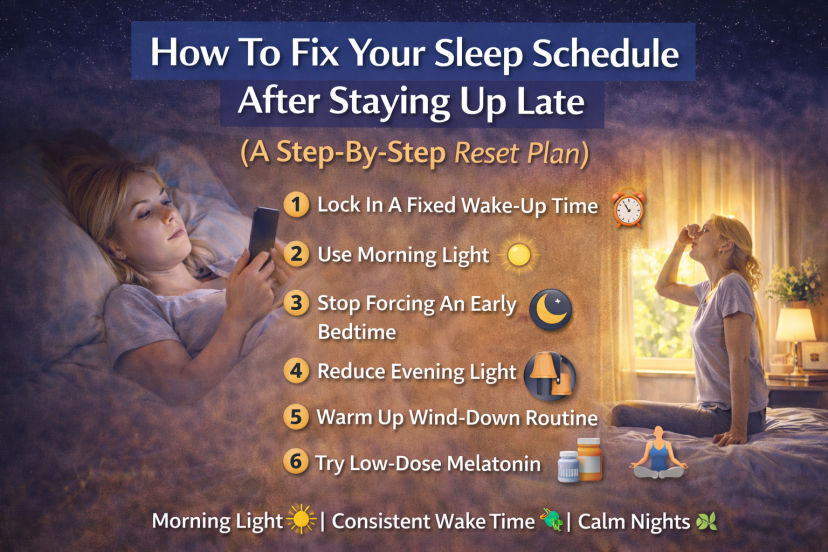
How To Fix Your Sleep Schedule After Staying Up Late (A Step-By-Step Reset Plan)
When One Late Night Turns Into A Broken Sleep Schedule
It starts with one late night—Netflix, work, scrolling, or stress. Then suddenly you’re wide awake at 1 or 2 a.m., sleeping in, and feeling exhausted but wired. Your mind races at bedtime, mornings feel brutal, and your sleep rhythm feels completely off.
If you’re trying to fix your sleep schedule, you’re not alone. This is one of the most common sleep struggles today—and the good news is that your body clock is adaptable. With the right approach, you can reset your sleep cycle naturally without forcing sleep or relying on medication.
This guide gives you a clear, gentle, step-by-step strategy to realign your circadian rhythm and restore healthy, consistent sleep.
🧠 Why Staying Up Late Breaks Your Sleep Rhythm
Your body runs on an internal clock called the circadian rhythm. It controls:
-
Sleep and wake timing
-
Hormone release (melatonin and cortisol)
-
Body temperature
-
Energy and alertness
When you stay up late repeatedly, this clock shifts later—especially if light exposure and wake times change too.
Common causes of a broken sleep rhythm include:
-
Late-night screen use
-
Irregular bedtimes and wake times
-
Sleeping in to “catch up.”
-
Stress or racing thoughts
-
Caffeine or late meals
Over time, your brain starts signaling “night” and “morning” at the wrong times.
😴 Signs Your Sleep Schedule Is Off
You may need to reset your sleep cycle if you notice:
-
Difficulty falling asleep before midnight
-
Feeling alert late at night but exhausted in the morning
-
Needing alarms (or multiple alarms) to wake up
-
Brain fog or low energy during the day
-
Strong urges to nap or sleep in
These are signals—not failures. Your body clock just needs guidance.
⏰ How To Fix Your Sleep Schedule (The Right Way)
The biggest mistake people make is trying to force sleep earlier. That usually backfires.
Instead, the goal is to shift your sleep rhythm gradually and consistently.
✅ Step 1: Lock In A Fixed Wake-Up Time
This is the most important step to fix your sleep schedule.
-
Choose a wake-up time you can maintain daily
-
Wake up at the same time every day, including weekends
-
Even after a bad night, get up on schedule
Your wake-up time anchors your entire sleep rhythm. Bedtime will follow naturally.
🌞 Step 2: Use Morning Light To Reset Your Sleep Cycle
Light is the strongest signal for your circadian clock.
Do this within 30 minutes of waking:
-
Go outside for 10–30 minutes
-
Sit near a bright window
-
Avoid sunglasses if safe
Morning light tells your brain, “This is daytime.” That helps melatonin release earlier the following night.
🌙 Step 3: Stop Chasing An Earlier Bedtime
Trying to go to bed early before your body is ready increases frustration and insomnia.
Instead:
-
Go to bed only when sleepy
-
Let bedtime shift earlier gradually (15–30 minutes every few days)
-
Focus on consistency, not perfection
Sleep pressure builds naturally when wake times are stable.
📵 Step 4: Reduce Light Exposure At Night
Artificial light—especially from screens—delays melatonin release.
Evening light rules:
-
Dim lights 90 minutes before bed
-
Use warm, low lighting
-
Avoid phones and laptops in bed
-
Use blue-light filters if screens are necessary
This helps your brain recognize nighttime again.
🌿 Step 5: Create A Calm Wind-Down Routine
A predictable routine signals safety and rest.
Effective wind-down habits include:
-
Light stretching or gentle yoga
-
Reading (paper book or e-reader on warm mode)
-
Breathing exercises
-
Journaling to offload thoughts
Keep it simple and repeat it nightly.
💊 Step 6: Support Your Reset With Gentle Sleep Aids
Supplements aren’t required—but they can help in the short term.
🧩 Melatonin (Low Dose)
-
Dose: 0.3–1 mg
-
Timing: 2–3 hours before desired bedtime
-
Best for circadian rhythm shifting
🧩 Magnesium Glycinate
-
Dose: 200–400 mg in the evening
-
Supports relaxation and a calm nervous system
🌿 Herbal Teas
-
Chamomile
-
Lemon balm
-
Passionflower
Avoid high doses or long-term reliance.
🦵 Step 7: Use Daytime Habits To Reinforce Your Sleep Rhythm
Your days shape your nights.
💪 Daytime Rules That Help Fix Sleep Schedule
-
Get sunlight again in the afternoon
-
Exercise earlier in the day
-
Avoid naps longer than 20–30 minutes
-
Cut caffeine after 1–2 p.m.
These strengthen bedtime consistency.
🚫 What NOT To Do When Resetting Your Sleep Schedule
-
Sleeping in after late nights
-
Taking long afternoon naps
-
Going to bed hours earlier than usual
-
Watching the clock at night
-
Using alcohol to “knock yourself out.”
These delay recovery.
🛏️ Sleep Environment Tips That Make Resetting Easier
Your bedroom should support your new rhythm.
Helpful tools for U.S. readers include:
-
White noise machines to reduce awakenings
-
Blackout curtains
-
Cooler temperatures (65–68°F)
-
Sleep trackers to observe patterns—not obsess
Consistency beats gadgets, but comfort matters.
🧠 How Long Does It Take To Reset Your Sleep Cycle?
Most people notice improvement within:
-
3–5 days: Falling asleep more easily
-
1–2 weeks: More stable sleep rhythm
-
2–3 weeks: Full circadian adjustment
Be patient. Your clock needs repetition, not pressure
🩺 When To See A Doctor
Consult a sleep professional if:
-
You can’t fix your sleep schedule after 3–4 weeks
-
Insomnia severely affects daily function
-
Anxiety or depression worsens
-
You rely on sleep medications regularly
-
You suspect a circadian rhythm disorder
Medical guidance can be very effective when needed.
❓ FAQs: Fix Sleep Schedule
1. Can I fix my sleep schedule in one night?
No. Circadian rhythms shift gradually over days.
2. Is staying up later to get tired helpful?
Sometimes briefly—but only with a fixed wake time.
3. Should I nap while resetting my sleep cycle?
Short naps are okay, but avoid late or long naps.
4. Does melatonin reset the sleep schedule?
Low doses can help shift timing in the short term.
5. Is sleeping in on weekends bad?
Yes. It disrupts bedtime consistency.
6. Can exercise help reset sleep rhythm?
Yes—especially morning or afternoon exercise.
7. Will my sleep return to normal?
Absolutely. The body clock is adaptable.
✅ Conclusion: Your Sleep Clock Is Fixable
If your sleep schedule feels broken, it doesn’t mean your sleep is. With consistent wake times, morning light, and gentle routines, you can fix your sleep schedule naturally and sustainably.
Start with one habit today. Your body knows how to sleep—it just needs clear signals again.
⚠️ Disclaimer
This article is for educational purposes only and does not replace medical advice. Always consult a qualified healthcare professional before starting supplements or if sleep problems persist or worsen.
 Explore more:
- Best Bedroom Temperature For Deep Sleep
- Melatonin vs Magnesium for Sleep
- Blue Light And Sleep: Why Screens Keep You Awake