What Is Core Sleep? (And Why It Matters More Than You Think)

🌙 Why People Are Talking About Core Sleep
You might have heard the term “core sleep” recently—especially in sleep apps, health trackers, or wellness content.
But what does it actually mean?
And more importantly…
Is core sleep something you should focus on improving?
The short answer: yes.
Because even if you’re getting enough hours of sleep, you might still feel tired if your core sleep isn’t strong.
⚡ Quick Answer
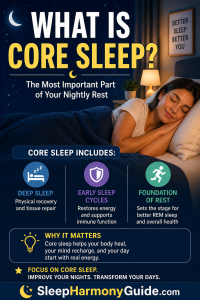
Core sleep is the most essential part of your nightly sleep, focused mainly on deep sleep and early sleep cycles that your body needs for physical recovery and basic functioning.
It usually happens in the first 3–5 hours after you fall asleep.

During this time, your body:
- Repairs tissues and muscles
- Strengthens your immune system
- Releases important hormones
- Restores physical energy
Without enough core sleep, you can feel exhausted—even after a full night in bed.
🧠 Understanding Sleep Stages (Simple Breakdown)
To understand core sleep, you need a quick look at how sleep works.
Your sleep is made up of cycles that repeat every 90 minutes.
Each cycle includes:
1. Light Sleep (Stage 1 & 2)
- You drift in and out of sleep
- Easy to wake up
- The body starts to relax
2. Deep Sleep (Slow-Wave Sleep)
- Harder to wake up
- The body repairs and restores itself
- Most physical recovery happens here
3. REM Sleep (Dream Sleep)
- Brain activity increases
- Important for memory and learning
- Emotional processing happens
Core sleep = mostly deep sleep + early sleep cycles
🛏️ Why Core Sleep Is So Important
Many people focus on how long they sleep.
But sleep quality matters just as much—if not more.
Here’s Why Core Sleep Matters:
- Physical Recovery: Muscles and tissues repair during deep sleep
- Immune Support: Your body strengthens defenses against illness
- Energy Restoration: You wake up feeling refreshed
- Hormone Balance: Growth hormone is released during deep sleep
- Metabolism Support: Poor sleep can affect weight and appetite
Think of core sleep as the foundation of your sleep.
Without it, everything else feels off.

😴 Core Sleep vs Deep Sleep: What’s The Difference?
These two terms are often confused.
Core Sleep:
- Refers to the most essential portion of your sleep
- Includes deep sleep + early cycles
- Focused on survival and basic function
Deep Sleep:
- A specific stage of sleep (slow-wave sleep)
- Happens mostly during the first half of the night
Deep sleep is part of core sleep—but core sleep is a broader concept.
⏰ When Does Core Sleep Happen?
Core sleep usually happens:
- In the first half of the night
- Within the first 3–5 hours after falling asleep
This is why going to bed late can hurt your sleep quality—even if you sleep in later.
Example:
- Sleep from 10 PM – 6 AM → strong core sleep
- Sleep from 2 AM – 10 AM → weaker core sleep
Timing matters—not just total hours.
🚫 Signs You’re Not Getting Enough Core Sleep
Even if you sleep 7–8 hours, poor core sleep can show up as:
- Feeling tired in the morning
- Brain fog or low focus
- Low energy during the day
- Frequent waking at night
- Getting sick more often
- Craving sugar or caffeine
If this sounds familiar, your sleep quality—not just quantity—may be the issue.
🔍 What Affects Your Core Sleep?
Several factors can reduce the amount of core sleep you get.
Common Disruptors:
- Late-night screen use
- Irregular sleep schedule
- Stress and anxiety
- Caffeine too late in the day
- Alcohol before bed
- Sleeping in a noisy or bright room
These factors interrupt deep sleep and early sleep cycles.
🔧 How To Improve Your Core Sleep (Step-By-Step)
If you want better sleep, this is where to focus.
🕒 1. Go To Bed Earlier (This Is Critical)
Because core sleep happens early in the night:
The earlier you sleep, the better your core sleep.
Simple Rule:
- Aim to sleep before 11 PM
- Ideally closer to 10 PM
This aligns with your natural body rhythm.
📅 2. Keep A Consistent Sleep Schedule
Your body thrives on routine.
Do This:
- Go to bed at the same time every night
- Wake up at the same time every morning
Even small variations can disrupt your sleep cycles.
📵 3. Reduce Stimulation Before Bed
Your brain needs time to slow down.
Avoid:
- Social media scrolling
- Bright screens
- Intense shows or work
Try Instead:
- Reading
- Calm music
- Light stretching
💡 4. Manage Light Exposure
Light directly affects your sleep hormones.
During The Day:
- Get natural sunlight early
At Night:
- Dim lights 1–2 hours before bed
This helps your body produce melatonin naturally.
🌡️ 5. Optimize Your Sleep Environment
Make your room support deep sleep.
Ideal Setup:
- Cool temperature (16–20°C)
- Dark room
- Quiet environment
Even small improvements here can increase deep sleep.
☕ 6. Watch Caffeine And Alcohol
Both can disrupt your core sleep.
Guidelines:
- Avoid caffeine after 1–2 PM
- Limit alcohol before bed
Even if alcohol makes you sleepy, it reduces the quality of deep sleep.
🧘 7. Relax Your Mind Before Sleep
A busy mind = poor sleep.
Try:
- Journaling your thoughts
- Breathing exercises
- Meditation
This helps your body transition into deeper sleep faster.
🏃 8. Move During The Day
Physical activity improves sleep depth.
Best Practice:
- Exercise earlier in the day
- Avoid intense workouts late at night
📱 Do Sleep Trackers Measure Core Sleep Accurately?
Devices like smartwatches often show “core sleep” or “deep sleep.”
But here’s the truth:
They are estimates—not perfectly accurate measurements.
They can still be useful for:
- Tracking trends over time
- Noticing improvements
Just don’t rely on exact numbers.
⏳ How Much Core Sleep Do You Need?
There’s no exact number—but most adults need:
- 1.5–2 hours of deep sleep per night
- Strong early sleep cycles
The focus should be on quality and consistency, not perfection.
🧩 Simple Night Routine To Boost Core Sleep
Here’s a realistic example:
- 9:00 PM – Dim lights
- 9:30 PM – Relax (reading/stretching)
- 10:00 PM – Bedtime
- Morning – Wake at the same time
Consistency here makes a huge difference.
❓ FAQ: What Is Core Sleep?
Is Core Sleep More Important Than REM Sleep?
Both are important—but core sleep is more focused on physical recovery, while REM supports mental and emotional health.
Can You Catch Up On Core Sleep?
Not fully. You can recover a bit, but consistent sleep is more effective than trying to catch up.
Why Do I Feel Tired Even After 8 Hours Of Sleep?
You may not be getting enough deep/core sleep due to poor quality or disrupted cycles.
Does Age Affect Core Sleep?
Yes. Deep sleep tends to decrease as you get older.
🌟 Final Thoughts: Focus On What Really Matters
If you’ve been asking “what is core sleep”, now you know:
It’s the most important part of your sleep for recovery and energy.
And improving it doesn’t require complicated solutions.
Focus on:
- Going to bed earlier
- Keeping a consistent schedule
- Reducing nighttime stimulation
- Creating a sleep-friendly environment
Start with just 2–3 changes tonight.
Stay consistent.
And your sleep will improve—naturally.
⚠️ Disclaimer
This content is for informational purposes only and is not intended as medical advice. Always consult a qualified healthcare professional if you have ongoing sleep problems or health concerns.
 Explore more:
- Why Am I Always Tired After Sleeping?
- Why Do I Wake Up Tired?
- Why Do I Wake Up At 3 AM Every Night After 40?